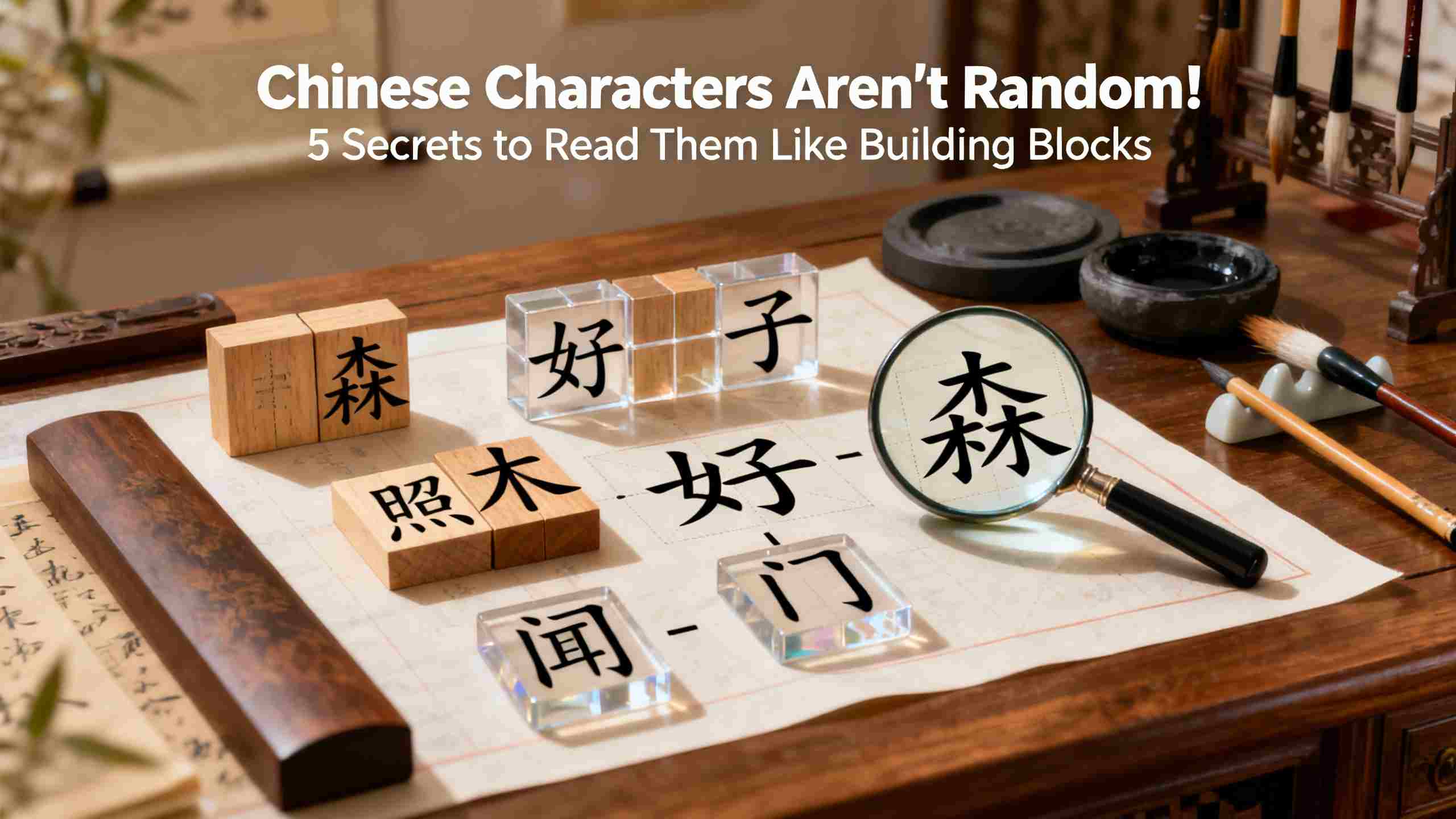
Chinese Characters Aren't Random! 5 Secrets to Read Them Like Building Blocks
Unlock the mysteries of Chinese characters by learning about radicals and structure. Discover how to read them like building blocks with these 5 secrets.
First time seeing Chinese characters? Do they look like mysterious symbols?
Don't worry! Every character has a hidden "user manual" — just like building block instructions.
Today you'll learn the core system of Chinese characters: radicals and structure.
By the end, you'll understand why "ice" has two dots, and why "mom" contains the "woman" element!
Secret 1: Radicals = Character Family Names (Find the Group)
Imagine a giant phone book with all names mixed together. Finding "Zhang Wei" would take forever! Radicals are like family names — they tell you which group a character belongs to.
8 Essential Radicals (Cover 60% of common characters)
| Radical | Pronunciation | Meaning Group | How to Spot It | Example Characters | Helpful Note |
|---|---|---|---|---|---|
| 氵 | shui | Water/Liquids | Three dots on left | river (河 hé), sea (海 hǎi), wash (洗 xǐ) | Most water-related characters have this radical |
| 冫 | bing | Ice/Cold | Two dots on left | ice (冰 bīng), cold (冷 lěng) | Only appears in a few common characters |
| 木 | mù | Trees/Wood | Contains "tree" shape | forest (林 lín), wood (木 mù) | One of the most common radicals |
| 讠 | yán | Speech | On left side | speak (说 shuō), words (话 huà) | Used in most communication characters |
| 忄 | xīn | Heart/Feelings | Vertical bars on left | happy (快 kuài), feeling (情 qíng) | Appears only on the left side |
| 扌 | shǒu | Hand Actions | On left side | hit (打 dǎ), hold (抱 bào) | Indicates physical hand movements |
| ⻌ | chuò | Walking/Roads | Bottom-left corner | go (过 guò), far (远 yuǎn) | Always indicates movement |
| ⺮ | zhú | Bamboo | Top section | pen (笔 bǐ), basket (篮 lán) | Appears in tools made from bamboo |
Practical Tip: Recognize "Ice" Instantly!
See "ice" (冰) on a menu or weather app? Notice the 冫 (two dots) → this always indicates "ice" or "cold"!
(This works for "ice cream" too — the first character "冰" has these two dots!)
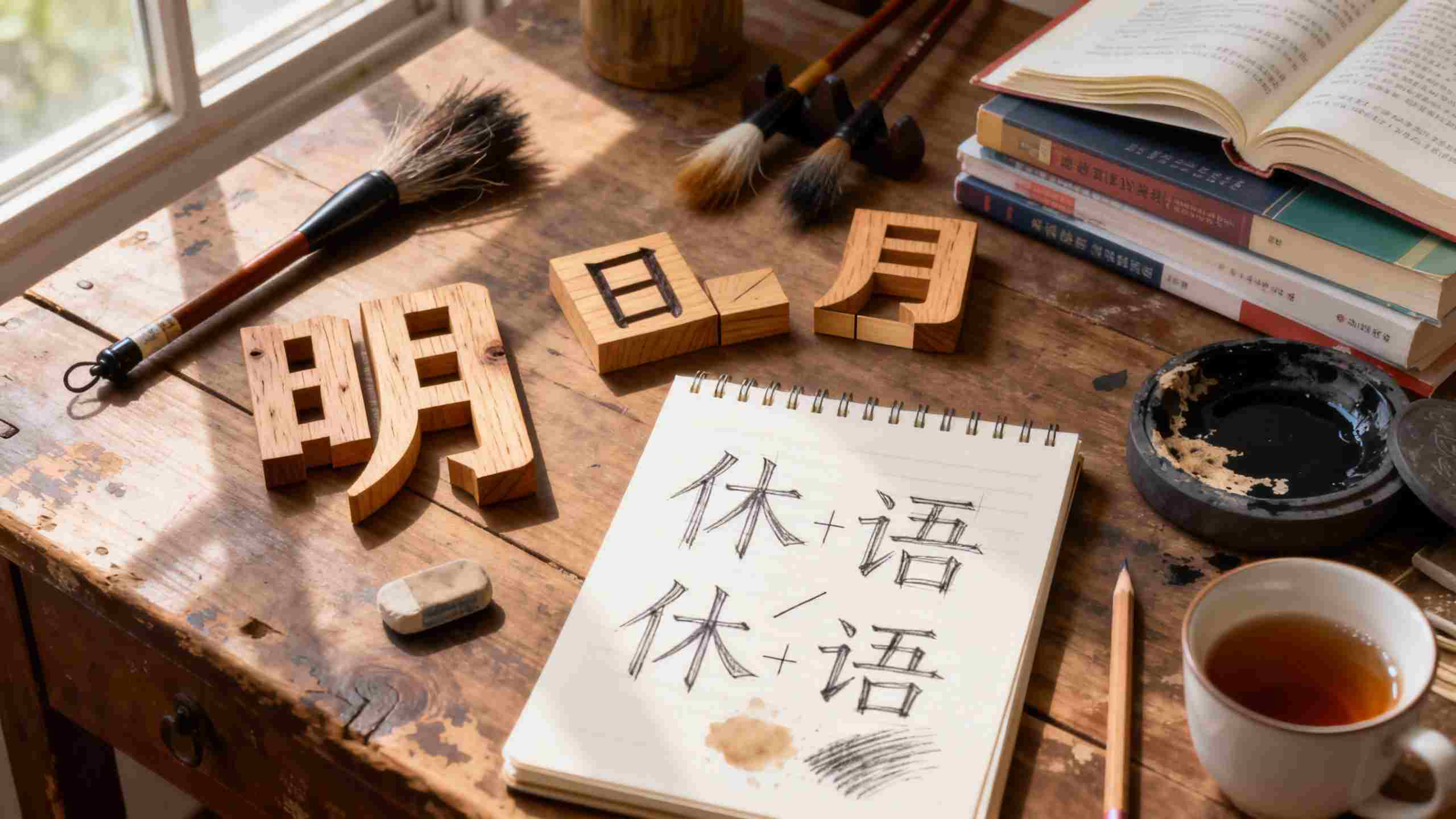
Secret 2: Structure = Building Block Patterns (Take It Apart!)
Characters aren't random strokes — they're built from 2-4 components! Learn these 5 patterns to decode characters:
5 Common Structures (With Real Examples)
-
Left + Right = Meaning + Sound (Most common!)
Mom (妈 mā) = woman (女 nǚ) + horse (马 mǎ)
- "Woman" gives meaning (female), "horse" gives sound (mǎ → mā)
Other examples: - Clear (清 qīng) = water (氵) + 青 (qīng) → Pure water
- Eat (吃 chī) = mouth (口 kǒu) + 乞 (qǐ) → Using mouth to eat
- "Woman" gives meaning (female), "horse" gives sound (mǎ → mā)
-
Top + Bottom = Combined Meaning
Character (字 zì) = roof (宀 mián) + child (子 zǐ)
- "Roof over a child" represents written characters
Other examples: - Divide (分 fēn) = knife (刀 dāo) + eight (八 bā) → Cutting into parts
- Forget (忘 wàng) = lose (亡 wáng) + heart (心 xīn) → Heart losing something
- "Roof over a child" represents written characters
-
Box Shape = Contained Concept
Country (国 guó) = box (囗) + jade (玉 yù)
- "Box protecting something valuable"
Other examples: - Trapped (困 kùn) = box (囗) + tree (木 mù) → Tree inside box
- Picture (图 tú) = box (囗) + winter (冬 dōng) → Area within boundaries
- "Box protecting something valuable"
-
Half-Box Shape = Movement
This (这 zhè) = walk (辶 chuò) + pattern (文 wén)
- "Walking" radical shows movement toward something
Other examples: - Sick (病 bìng) = sickbed (疒) + 丙 (bǐng) → Lying on a sickbed
- Sentence (句 jù) = wrap (勹 bāo) + mouth (口 kǒu) → Words contained in speech
- "Walking" radical shows movement toward something
-
Complex Combinations
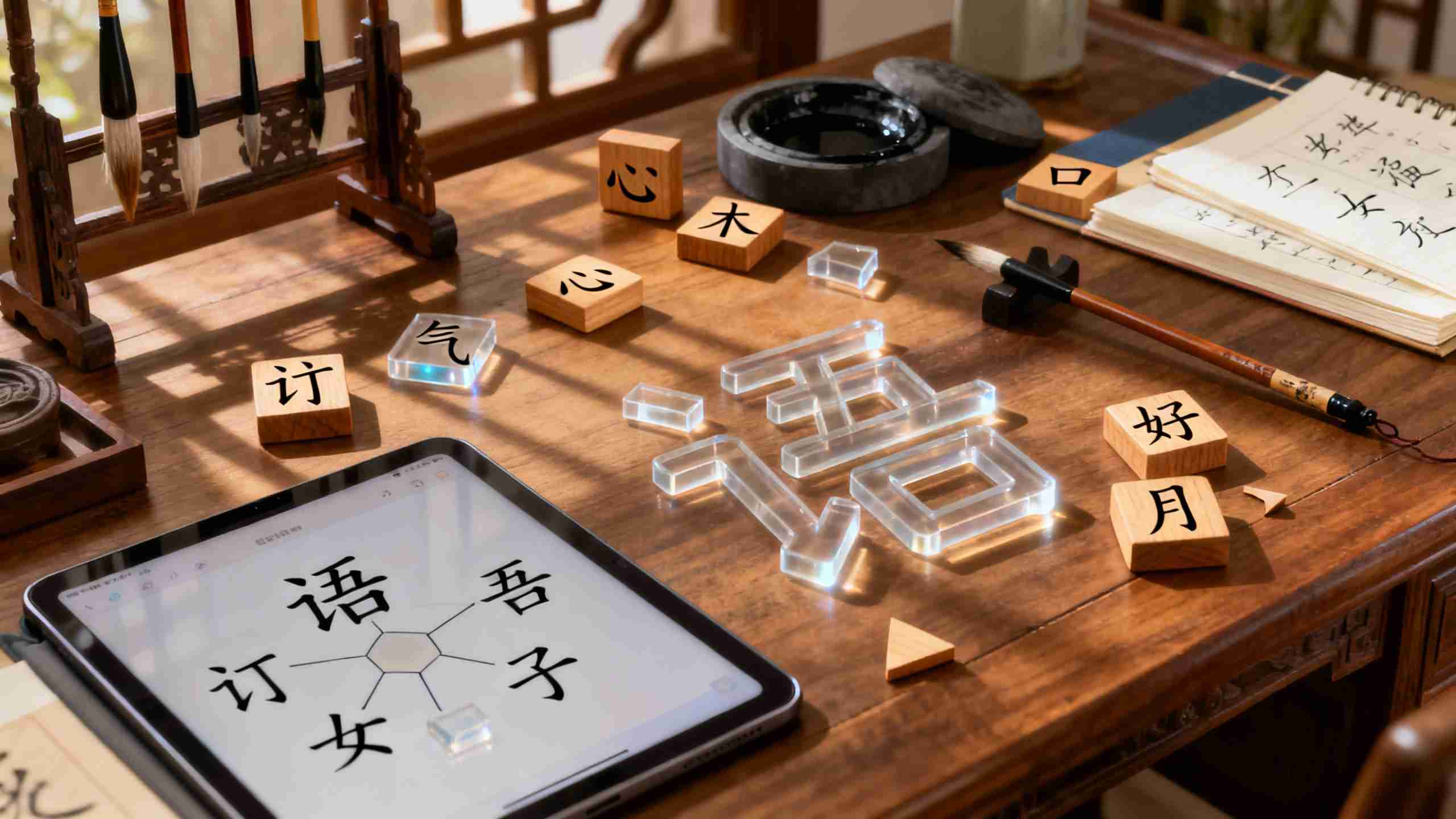
Win (赢 yíng) = Multiple components
- This is an advanced character. Beginners should focus on simpler patterns first!
(Note: The component 贝 bèi in other characters often relates to money or value)
- This is an advanced character. Beginners should focus on simpler patterns first!
Phone Dictionary Trick:
In apps like Pleco, draw the radical FIRST!
Example: Looking for "sick" (病)? Draw 疒 (sickbed shape) → app instantly shows related characters.
Secret 3: Avoid 3 Common Mistakes (Teachers Rarely Mention)
Mistake 1: Confusing similar radicals
- Problem: Mixing up 礻 (one dot) vs 衤 (two dots)
- Memory Trick:
"Two dots for clothes,
One dot for rituals"
("Gift" 礼 lǐ uses the one-dot radical 礻) - Visual Comparison:
礼 ❌ (衤 + 勿) = "clothing + don't"? 礼 ✅ (礻 + 勿) = correct character for "gift"
Mistake 2: Confusing "buy" and "sell"
- Problem: Not knowing "buy" (买 mǎi) = getting items, "sell" (卖 mài) = giving items
- Memory Trick:
Top of "buy" (买) resembles a shopping bag (bringing things in)
Top of "sell" (卖) resembles an upward arrow (sending things out)
Mistake 3: Forgetting "heart" changes shape
- Truth:
- Bottom "heart": 心 → think (想 xiǎng), love (爱 ài)
- Left "heart": 忄 → happy (快 kuài), busy (忙 máng)
- Memory Trick:
"Heart on the left stands up straight,
Two lines like a narrow gate"
Secret 4: Cultural Insights in Characters
Characters reflect how ancient Chinese people saw the world:
Nature and Daily Life
- "Rest" (休 xiū) = person (人) + tree (木) → Person leaning against a tree taking rest
- "Home" (家 jiā) = roof (宀) + pig (豕 shǐ)
In ancient times, pigs were kept under houses. "Roof over a pig" meant a complete home where people lived with their animals
Family Values
- "Peace" (安 ān) = roof (宀) + woman (女 nǚ)
"Woman under roof" represented safety and stability in traditional households
- "Good" (好 hǎo) = woman (女 nǚ) + child (子 zǐ)
Shows the traditional value placed on family continuity
Note: These reflect historical perspectives, not necessarily modern views. Chinese culture has evolved significantly over time.
Secret 5: Your Turn! Character Decoding Practice
Use today's secrets to analyze these:
-
"Lake" (湖 hú)
- Radical: ______ → Related to ______
- Structure: ______ + ______
- Meaning connection: ________________________
-
"Run" (跑 pǎo)
- Radical: ______ → Related to ______
- Structure: ______ + ______
- How is it different from "walk" (走)? ________________________
-
"Smile" (笑 xiào)
- Radical: ______ → Related to ______
- Structure: ______ + ______
Answers (Try first!):
- Lake = water radical (氵) + 胡 (hú) → Large body of water
- Run = walking radical (⻌) + 包 (bāo) → Movement with body contained = running
- Smile = bamboo radical (⺮) + 夭 (yāo) → Bamboo bends easily, like a smiling person
You're Now a Character Decoder!
Next time you see a new character, use this simple method:
- Find the radical (check left/top/surrounding parts)
- Identify the structure (Left+Right? Top+Bottom?)
- Guess the meaning (based on the radical)
Try it now:
Look at any Chinese text around you (a restaurant menu, a language app, or even this article).
Pick one character you don't know and try to decode it using these secrets!
You now have a powerful tool to understand Chinese characters — one building block at a time.
Note for learners:
Chinese characters evolved over 3,000+ years. Some connections between form and meaning aren't obvious today.
Focus on recognizing patterns rather than memorizing every detail. Even native speakers learn characters gradually!
Related Articles
How to Pronounce Chinese Names with Pinyin: A Practical Guide for Non-Native Speakers
A practical guide to pronouncing Chinese names written in pinyin, covering name structure, pinyin basics, common patterns, and practice tips for non-native speakers.
Modern Chinese Names: What Kids Are Actually Called Now
Forget Li Ming and Wang Wei. A ground-level look at what Chinese kids are really named today, what those names signal, and how to sound modern without sounding ridiculous.
Why Most Chinese Name Generators Are Dangerous (Don't Get a Tattoo Yet!)
Before you tattoo a ‘cool Chinese name’ or launch a brand with it, read this. A brutally honest look at how most Chinese name generators actually work — and why they can quietly ruin your skin, your brand, or your reputation.