How to Pronounce Chinese Names with Pinyin: A Practical Guide for Non-Native Speakers
A practical guide to pronouncing Chinese names written in pinyin, covering name structure, pinyin basics, common patterns, and practice tips for non-native speakers.
If you work with Chinese colleagues, have Chinese friends, or you’re choosing a Chinese name for yourself, one thing becomes very clear:
Getting people’s names right matters.
Chinese names are usually written in pinyin, the official Romanization system for Mandarin. The letters look familiar, but the sounds — and especially the tones — are not the same as English.
In this guide we’ll cover:
- How Chinese names are structured
- A quick pinyin crash course, focused on names
- Step-by-step: how to pronounce a Chinese name you see in pinyin
- Common surname and given name patterns
- Typical mistakes foreigners make (and how to avoid them)
- A simple practice routine you can follow
How Chinese Names Are Structured
Most modern Chinese names follow this pattern:
Family name (surname) + Given name
1 Family name (姓, xìng)
- Usually one syllable (one character).
- It comes first, not last.
- A few are two syllables (e.g. Ōuyáng 欧阳, Sīmǎ 司马), but these are less common.
Examples of common one-syllable family names:
- 王 Wáng
- 李 Lǐ
- 张 Zhāng
- 刘 Liú
- 陈 Chén
- 杨 Yáng
- 赵 Zhào
- 黄 Huáng
2 Given name (名, míng)
- Usually one or two syllables (one or two characters).
- Often chosen for meaning: virtue, nature, wishes, qualities, etc.
- There is no strict “male/female” list, but some names are more typical for males or females.
Examples:
- One syllable: Huá 华, Méi 梅, Tāo 涛
- Two syllables: Jiāmíng 家明, Měilíng 美玲, Yǒngjūn 永军
3 Examples of full names
- 王家明 Wáng Jiāmíng
- 李娜 Lǐ Nà
- 张伟 Zhāng Wěi
- 陈美玲 Chén Měilíng
When you see “Zhang Wei” in English order, the original Chinese order is “Zhāng Wěi”: Zhāng is the family name, Wěi is the given name.
A Very Short Pinyin Crash Course (For Names)
Pinyin represents Chinese sounds using Latin letters. To pronounce names correctly, focus on:
- initials (beginning sounds)
- finals (vowel parts)
- tones (pitch patterns)
1 Key initials you’ll see in names
Some initials are similar to English:
- b, p, m, f → Bīn, Píng, Měi, Fēi
- d, t, n, l → Dōng, Tāo, Nà, Lì
- g, k, h → Guāng, Kē, Huá
Others are tricky and very common in names:
-
zh, ch, sh, r (retroflex, tongue curled slightly back)
- Zhāng 张
- Chén 陈
- Shān 山
- Róng 荣
-
j, q, x (palatal, tongue high near hard palate)
- Jīng 晶
- Qīng 青
- Xiào 晓
-
z, c, s (dental, tongue near teeth)
- Zǐ 子
- Cāi 蔡
- Sī 思
Very roughly:
- zh is like “j” but tongue curled back.
- q is like a sharp “chee” with spread lips.
- x is like a soft “sh” (similar to German “ich”).
2 Common finals in names
You’ll see certain endings again and again:
- -ang, -eng, -ong → Zhāng, Chéng, Yóng
- -an, -en, -in, -ing → Lán, Wén, Lín, Yīng
- -ao, -ai, -ei, -ui → Xiǎo, Hǎi, Lěi, Ruì
- -uan, -uanɡ, -un, -ong, -iong → Juān, Guāng, Jūn, Yōng, Xióng
And some very name-friendly syllables:
- Měi 美 (beautiful)
- Lì 丽 / 力 (beautiful / strength)
- Xīn 心 (heart), Xīn 欣 (joy)
- Hào 浩 (vast), Hào 皓 (bright)
- Yǒng 勇 (brave)
- Qīng 晴 / 青 (clear / green/blue)
3 Tones on names
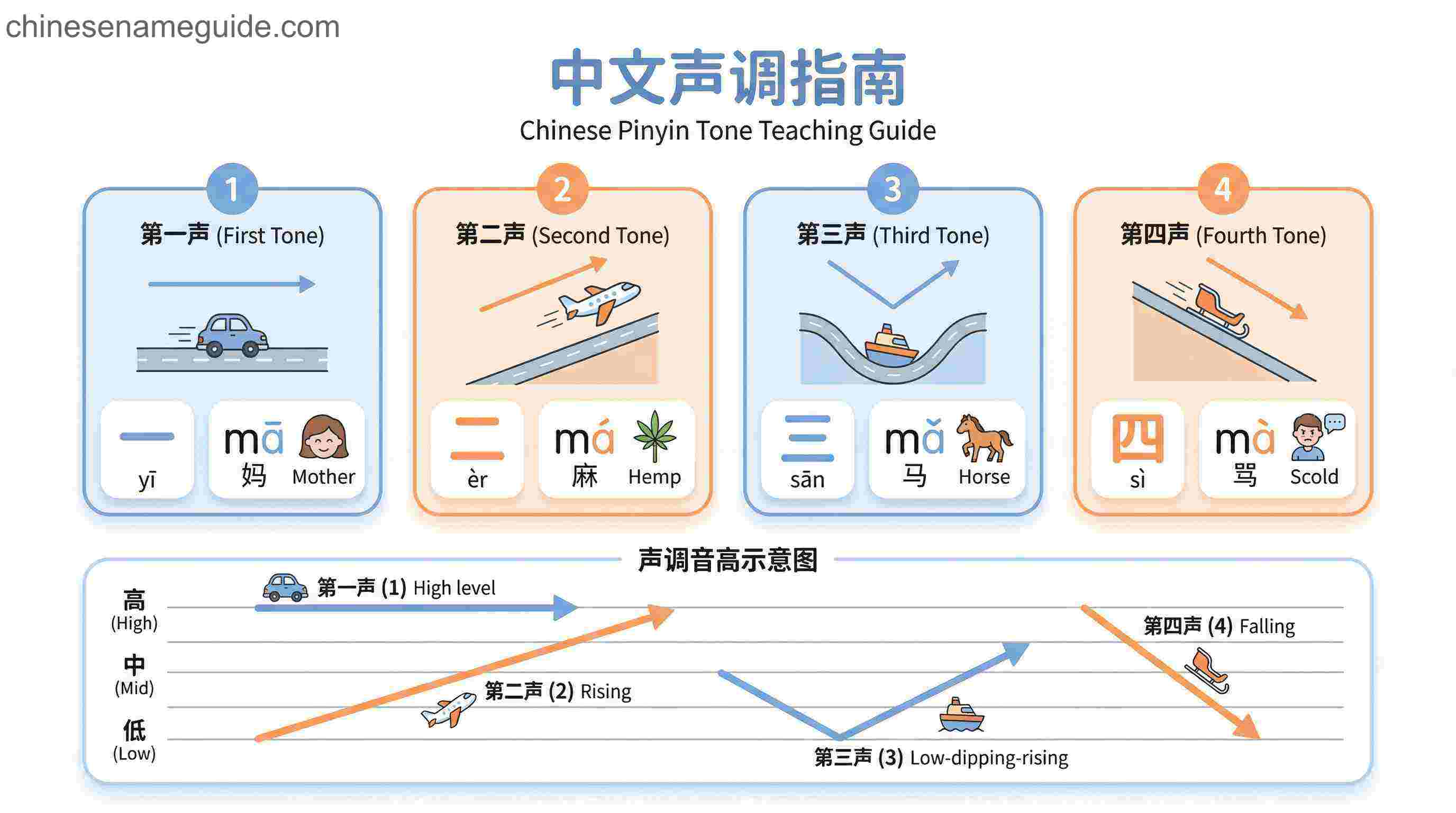
Each syllable in a Chinese name has a tone:
- First tone: high and level → Zhāng 张 (Zhāng Wěi)
- Second tone: rising → Míng 明 (Wáng Míng)
- Third tone: low dipping → Wěi 伟, Xiǎo 小
- Fourth tone: falling → Lì 丽, Qìng 庆
In pinyin, tones are shown with marks: ā á ǎ à.
When tones are missing (for example in passports or email addresses), you have to guess or ask the person.
Step-by-Step: How to Pronounce a Name You See in Pinyin
Let’s say you see the name: Zhang Jia Ming.
Step 1: Restore Chinese name order and syllables
- Likely written in English order: Zhang Jia Ming
- In Chinese order with tones: Zhāng Jiāmíng (张家明)
Break into syllables:
- Zhāng
- Jiā
- Míng
Step 2: Identify initials and finals
- Zhāng → zh + ang
- Jiā → j + ia
- Míng → m + ing
This helps you know where to put your tongue:
- zh: tongue curled back
- j: tongue high near hard palate, lips unrounded
- ing: like English “ing” in “sing”, but keep it short and clean
Step 3: Note the tones
Let’s say the tones are:
- Zhāng (first tone)
- Jiā (first tone)
- Míng (second tone)
Visually:
- Zhāng → — (high flat)
- Jiā → — (high flat)
- Míng → ˊ (rising)
You can think: HIGH – HIGH – RISING.
Step 4: Say it smoothly with a Chinese rhythm
Instead of English stress like “ZHANG jia MING”, aim for:
- Syllable-timed: Zhāng Jiā Míng (each syllable similar length)
- Let tones carry the melody, not English stress.
Common Chinese Surnames and How to Say Them
Here are some of the most common surnames, with pinyin + tone and an approximate English hint:
- 王 Wáng (Wang, rising tone) – “wong?” with a rising pitch
- 李 Lǐ (Li, dipping) – “lee” but low and slightly rising
- 张 Zhāng (Zhang, high) – “jahng” but tongue curled back and high level tone
- 刘 Liú (Liu, rising) – “lyoh?” with rising tone
- 陈 Chén (Chen, rising-ish, in fast speech) – “chun” (like “churn” without r)
- 杨 Yáng (Yang, rising) – “yahng?”
- 赵 Zhào (Zhao, falling) – “jow!” (rhymes with “cow”) with sharp falling tone
- 黄 Huáng (Huang, rising) – “h-wong?”
- 吴 Wú (Wu, rising) – “woo?” with rising tone
- 周 Zhōu (Zhou, high) – “joe” but tongue more tense and high level tone
📌 For your own Chinese name, picking a common, easy surname (like Wáng, Lǐ, Zhāng) makes your name more natural and easier to remember.
Patterns in Given Names
Most given names are one or two syllables. Two-syllable names are extremely common.
1 One-syllable given names
Examples:
- 明 Míng (bright)
- 伟 Wěi (great)
- 芳 Fāng (fragrant)
- 婷 Tíng (graceful)
These are often combined with the family name:
- 王明 Wáng Míng
- 李伟 Lǐ Wěi
2 Two-syllable given names
Very common structure:
Family name (1 syllable) + Given name (2 syllables)
Examples:
- 王家明 Wáng Jiāmíng
- 李美玲 Lǐ Měilíng
- 陈思远 Chén Sīyuǎn
- 张小龙 Zhāng Xiǎolóng
Pronunciation tips:
- Say each syllable clearly with its tone:
- Wáng (2nd tone) + Jiā (1st tone) + míng (2nd tone)
- Avoid English-style stress like “WANG jiá MING” — let tones shape the melody instead.
Typical Mistakes Foreigners Make
If your first language is English (or another non-tonal language), you’re not alone. These are the most common issues:
1 Ignoring tones completely
Saying “Zhang Wei” with a flat, English-like melody makes it harder for Chinese speakers to recognize which name you mean.
- Correct: Zhāng Wěi (first tone + third tone)
- Incorrect: “zhang way” with random intonation
Even an approximate tone is better than none.
2 Using English stress instead of tones
English loves strong stress on one syllable (“KEnneth”, “MaRY”). Mandarin doesn’t work like that.
- English pattern: “ZHANG wei” (first syllable stressed)
- Better Mandarin pattern: Zhāng Wěi (both syllables clear, tones define pitch)
3 Misreading pinyin letters
Examples:
-
q read as “k” or “kw”
- Correct: like “chee” → Qīn (not “kin”)
-
x read as “ks” or “z”
- Correct: soft “sh” → Xīn (not “zin”)
-
zh read as simple “z” or “j”
- Correct: retroflex “j” sound → Zhāng (not “jang” or “zang”)
4 Mixing up -n and -ng
- Lín vs Líng
- Wǎn vs Wǎng
To fix this:
- For -n, let the tip of your tongue touch the gum ridge behind your upper teeth.
- For -ng, keep the tip of your tongue down; close the back of your mouth like in “song”.
A Simple Practice Routine for Names
You don’t need a perfect study plan. A small, consistent routine is enough.
1 Pick 10 real names
Use real names of:
- your Chinese colleagues or friends
- famous people
- or a list from a Chinese name generator or textbook
Write them in pinyin with tones, e.g.:
- Zhāng Wěi
- Lǐ Nà
- Wáng Jiāmíng
- Chén Měilíng
- Zhào Yǒng
- Liú Xīn
2 For each name, do this:
- Mark the tones clearly (e.g. draw lines: — ˊ ˇ ˋ).
- Say each syllable alone, slowly:
- “Zhāng… Zhāng… Zhāng…”
- “Wěi… Wěi… Wěi…”
- Combine into the full name, keeping each tone:
- Zhāng Wěi → HIGH + DIPPING
- Record yourself and compare with a native speaker (if you have audio).
7.3 Ask people to correct you
If you already know Chinese speakers, ask them:
- “Did I say your name correctly?”
- “Can you say it slowly so I can copy you?”
Most people are happy you’re making the effort, and they’ll give you friendly feedback.
If You’re Choosing Your Own Chinese Name
If you’re picking a Chinese name for yourself, pronunciation should be part of your decision:
- Choose common, easy surnames like Wáng, Lǐ, Zhāng, Liú.
- For the given name, pick syllables that:
- you can pronounce comfortably
- don’t rely on very tricky sounds (like r + complex finals)
- have meanings you genuinely like
You can also:
- Let a native speaker check if your proposed name is natural.
- Use a Chinese name generator to get ideas and then refine them with a teacher or friend.
Conclusion
Chinese names may look simple in Roman letters, but they carry:
- specific sounds (pinyin initials and finals)
- precise tones
- deep meanings in the characters behind them
To pronounce Chinese names well, you don’t need to be perfect. You just need to:
- Break the name into syllables.
- Learn how its pinyin syllables sound.
- Pay attention to the tones.
- Practice with real names and friendly feedback.
Your Chinese friends and colleagues will notice the effort — and it’s one of the fastest ways to show respect for the language and the people who speak it.
Related Articles
A Friendly, Systematic Guide to Chinese Pronunciation for Beginners
A clear and systematic guide to mastering Chinese pronunciation, covering pinyin, tones, difficult sounds, and practical tips for improvement.

Common Tone Mistakes and How to Finally Fix Them
A deep, practical guide to the most common Mandarin tone mistakes learners make — with clear examples, explanations, and training strategies to fix them for good.