The Power of a Single Character: How 1-Character Chinese Names Really Work
In a world dominated by two-character Chinese given names, single-character names feel old, sharp, and strangely modern at the same time. This article explores where they come from, who uses them, and how to choose one without sounding like a cartoon villain.
Scroll through a modern Chinese baby-name ranking and you’ll see mostly two-character given names:
奕辰、子涵、宇轩、梓萱…
But every so often, a name pops up that’s just one character:
李刚 Lǐ Gāng 王宁 Wáng Níng 陈澄 Chén Chéng
Short. Blunt. Memorable.
In today’s naming landscape—where 2-character given names dominate—1-character names sit in a strange place: they can feel traditional, masculine, elite, minimalist, or just… old-fashioned, depending on the context.
This article unpacks that tension:
- how 1-character given names fit into Chinese naming history
- how common they actually are today
- what they signal about gender, age, and class
- when a 1-character name feels cool… and when it just feels weird
- how to choose a 1-character Chinese name as a learner without overdoing it
What exactly is a “1-character Chinese name”?
We need to be precise.
In modern Mandarin, a full name is usually:
[Surname 姓] + [Given name 名]
- Most surnames are one character: 李 Lǐ, 王 Wáng, 张 Zhāng, 陈 Chén, 刘 Liú, etc.
- Given names are one or two characters.
- So full names tend to be two or three characters long.
When people talk about “one-character Chinese names”, they’re usually talking about:
Given names that are a single character (so the full name still has at least the surname + that one character).
Examples:
- 张伟 Zhāng Wěi – surname 张 + given name 伟
- 王刚 Wáng Gāng – surname 王 + given name 刚
- 李静 Lǐ Jìng – surname 李 + given name 静
That’s different from a two-character full name like:
- 欧阳娜娜 Ōuyáng Nànà – here the surname is two characters (欧阳), the given name is two characters (娜娜).
- 司马懿 Sīmǎ Yì – two-character surname, one-character given name.
In this article, we focus on:
single-character given names among Han Chinese (regardless of whether the surname is one or two characters).
A very short history: from “almost everything” to “fashion minority”
1 In the beginning: 1-character given names dominate
Early in imperial history, most given names were one character. A famous example: during the short-lived Xin dynasty, Wang Mang reportedly banned two-character given names, and at one point over 98% of people had one-character given names.
Classical figures you meet in history books often have:
- one-character given names:
- 刘备 Liú Bèi
- 曹操 Cáo Cāo
- 赵云 Zhào Yún
- plus a courtesy name 字 or art name 号 that might be two characters.
2 Later dynasties: two-character given names rise
By the Tang and Song dynasties, two-character given names became more common, especially among elites. Over the Ming and Qing periods, the pattern “surname + two-character given name” became increasingly standard, reinforced by:
- clan generation-name systems (one shared character across a generation),
- growing population → need for more combinations and distinctiveness.
3 20th century: up-and-down, then 2-character dominance
Modern data show:
- Early/mid-20th century: two-character given names already the majority.
- 1950s–1980s: some regions saw more one-character given names, especially among men (e.g. 军 Jūn “army”, 刚 Gāng “hard/strong”, 强 Qiáng “strong”).
- 1990s onwards: two-character given names surge again; in some samples, around 80–90% of newborns have two-character given names, while single-character names shrink to a minority.
Today:
- Single-character given names are still used,
- but they’re a minority choice, and they carry a specific aesthetic and generational feel.
How 1-character names feel to native speakers
Ask 10 Chinese people what vibe a 1-character given name has, and you’ll hear variations of:
- “挺man的” – quite masculine
- “老一辈起名那种” – older generation style
- “要么很豪爽,要么很有个性” – either blunt/straightforward, or individualistic
Let’s break down the main associations.
1 Masculine, blunt, “no nonsense”
Because many single-character given names in the late 20th century were male and strong-sounding—think 军, 刚, 勇, 强, 伟—single-character given names lean masculine in the collective imagination.
Compare:
- 张强 Zhāng Qiáng – one hard character “strong”
- 张子强 Zhāng Zǐqiáng – same core word, but softened by 子 (a refined/neutral syllable)
The first feels more like:
- working-class, straightforward, practical, 70s/80s dad energy
The second could be:
- contemporary, slightly refined, maybe urban middle-class
2 Older generation / “auntie & uncle” flavour
In many families, grandparents and some parents have one-character given names, while their children and grandchildren mostly have two-character given names. That creates a generational pattern:
- Grandpa: 李刚 Lǐ Gāng
- Grandma: 王秀 Wáng Xiù
- Dad: 李德华 Lǐ Déhuá
- Child: 李宸宇 Lǐ Chényǔ
So when a 20-year-old has a one-character given name, it can feel deliberately “old-school” or “retro”.
3 Minimalist, elite, or stylised (in the right context)
In some circles—especially among artists, academics, or in fiction—one-character given names can feel:
- clean and minimalist
- sharp (like a brand logo)
- or slightly aloof / high-status
Think of:
- 孟非 Mèng Fēi (TV host)
- 韩寒 Hán Hán (writer; surname 韩, given name 寒)
In novels, wuxia, and dramas, powerful characters often have short names with weighty, evocative characters. The same applies to stage names: a single striking character can be very memorable.
So a 1-character Chinese given name today can be:
- uncle-next-door common,
- minimalist & stylised,
- or deliberately retro—
depending on the character and context.
What kinds of characters show up in 1-character given names?
Because you only have one slot, that character has to do a lot of work.
Common types include:
1 Strength & will
- 刚 Gāng – firm, hard
- 强 Qiáng – strong
- 勇 Yǒng – brave
- 力 Lì – strength
These scream masculine, straightforward, older-generation. You still see them, but they are less common for urban Gen-Z kids.
2 Virtue & character
- 德 Dé – virtue
- 诚 Chéng – sincerity
- 信 Xìn – trust
- 忠 Zhōng – loyalty
These have a serious, old-school flavour. As a single-character name, they feel weighty—sometimes too weighty for a casual modern vibe.
3 Calm & introspective
- 宁 Níng – peace, tranquil
- 安 Ān – peace, safe
- 澄 Chéng – clear, limpid
- 静 Jìng – quiet
These can work for any gender and often feel more timeless and minimalist than the brute-strength set.
4 Poetic / literary
- 寒 Hán – cold, winter chill (often poetic)
- 澜 / 瀾 Lán – big waves, grand water
- 舟 Zhōu – boat
- 竹 Zhú – bamboo
As single-character names, these tend to feel artsy or fictional, depending how common they are in real people’s names.
1-character vs 2-character given names: what you gain and lose
Choosing a single-character given name is not just an aesthetic choice; it changes how your name works.
1 Expressiveness vs compression
- 2-character given name: combine two ideas → more nuance
- 林静 – forest + quiet
- 宇航 – cosmos + navigation
- 1-character given name: one idea only → more compressed
Like logo design vs paragraph writing:
one character can be very strong, but you only get one shot.
2 Family generation names are harder
As we saw in the 2-character article, many families use one character as a shared generation marker, plus one free character.
A one-character given name doesn’t have space for that:
- either everyone in a generation literally has the same given name (impractical),
- or the family abandons the generation-name pattern.
So 1-character given names are more common in families without strong generation-name traditions, or where that tradition has faded.
3 Uniqueness vs collision
Paradoxically, while Chinese uses thousands of characters, a lot of name-friendly characters cluster in a fairly small subset. If everyone picks from that pool and you only get one chance, you see a lot of:
- 张伟, 王伟, 李伟
- 张静, 李静, 王静
—names that are extremely common.
Two-character given names make it easier to avoid these high-collision zones. With one character, you have to work harder to find something that is:
- common enough to be readable,
- but not so generic that you share your name with half a million people.
Should a non-native learner pick a 1-character given name?
You can, but you should do it with eyes open.
1 When it can work well
A single-character given name can be a good fit if:
-
You like minimalism and don’t mind standing out a bit A very short name is almost always memorable:
- 李澈 Lǐ chè
- 王宁 Wáng Níng
-
You’re okay with a slightly “old-school” or “serious” vibe Especially if you pick virtue/strength characters.
-
You have a clear persona in Chinese For public-facing work (writer, artist, content creator), a one-character given name can work like a stage name: sharp, brand-able, slightly stylised.
2 When it’s safer to go with 2 characters
You might want to avoid 1-character given names if:
- You want to blend in with 21st-century Mainland or Taiwan peers.
- Two-character given names are the default; single-character names can feel like outliers.
- You’re not confident yet with nuance (you’re picking by “looks cool” only).
- With two characters, you can soften or balance risky choices. With one, you either land it or you don’t.
- You care about generation naming or family patterns (for a future child, for example).
If in doubt, 2-character given names are more forgiving and more “standard” for non-native users.
How to design a 1-character Chinese given name (if you really want one)
If you do want to go the one-character route, here’s a practical workflow.
Step 1 – Fix a simple, common surname
Pick something like:
李 Lǐ, 王 Wáng, 张 Zhāng, 陈 Chén, 林 Lín, 周 Zhōu, 赵 Zhào…
These are extremely normal and let the given name carry the style.
Step 2 – Decide your direction: strong / calm / literary?
Ask yourself in English first:
Do I want to sound strong, calm, bookish, or poetic?
Rough mapping:
- Strong: 刚, 强, 勇, 力
- Calm: 宁, 安, 澄, 静
- Bookish/virtue: 文, 德, 诚, 信, 博
- Poetic: 寒, 澜/瀾, 竹, 牧, 禹
(Don’t just copy these; use them as starting seeds.)
Step 3 – Check frequency and real usage
Before falling in love with a character:
-
Look it up in a good dictionary:
- confirm meaning(s) are positive or neutral,
- make sure there are no strong negative or vulgar senses.
-
Search the full name (Surname + Character) in Chinese:
- if many real people have this name, it’s probably fine;
- if only one notorious criminal or meme appears, maybe pick something else.
Step 4 – Say it out loud, a lot
Try your full name:
Surname + Character
out loud at natural speed:
- Does it collide with a common phrase?
- Does it sound like a joke or pun you don’t intend?
- Does it end in a tone that makes daily calling awkward (e.g. some 4th-tone hammer effects with certain surnames)?
Ask at least one native speaker:
- “What’s your first impression of this name?”
- “Age/generation? Gender? Normal? Weird?”
Step 5 – Commit to the vibe
A one-character given name is a strong design choice. Don’t then bury it under a wildly different persona.
If you pick:
- 李刚 – expect “tough, older-school masculine” reactions.
- 王宁 – expect “calm, somewhat neutral” reactions.
- 林寒 – expect “slightly literary, moody winter” reactions.
Lean into it, don’t fight it.
A few example “profiles” (not templates to copy blindly)
To see how this plays out, here are three fictional examples.
Profile A – Calm, gender-neutral minimalist
- Surname: 王 Wáng
- Given name: 澄 Chéng (“clear, limpid”)
Full name: 王澄 Wáng Chéng
- Feels modern-acceptable, not macho.
- Works for any gender.
- Slightly artistic but not too pretentious.
Profile B – Retro-masculine, down-to-earth
- Surname: 李 Lǐ
- Given name: 刚 Gāng (“firm, hard”)
Full name: 李刚 Lǐ Gāng
- Feels like someone born in the 70s–80s, or a deliberately old-school persona.
- Very masculine; not subtle.
- Great if you want that vibe; strange if you’re a 22-year-old indie musician trying to be ethereal.
Profile C – Literary, slightly mysterious
- Surname: 林 Lín (“forest”)
- Given name: 寒 Hán (“cold, wintry”, often poetic)
Full name: 林寒 Lín Hán
- Feels like a novelist, screenwriter, or drama character.
- Leans a bit melancholic, but in a “poetry, black-and-white film” way.
- In daily life, might feel artsy; in creative work, very on-brand.
Takeaway: One character is not “less”—it’s different
In English, choosing “Tom” instead of “Theodore” is mostly about length and formality. In Chinese, choosing a 1-character given name over a 2-character one changes:
- how old you sound,
- how masculine/feminine/neutral you feel,
- how serious or stylised your name appears,
- how much “room” you have to encode meaning and family traditions.
Single-character given names aren’t “worse” or “better” than two-character names; they’re just heavier per syllable.
If you’re a non-native learner:
- defaulting to a two-character given name is the safest, most natural choice,
- but a well-chosen one-character name can be a powerful statement— especially if you know exactly what you’re doing with that one character.
After all, in Chinese, one character can be a whole poem if you pick it right. ::contentReference[oaicite:10]{index=10}
Related Articles
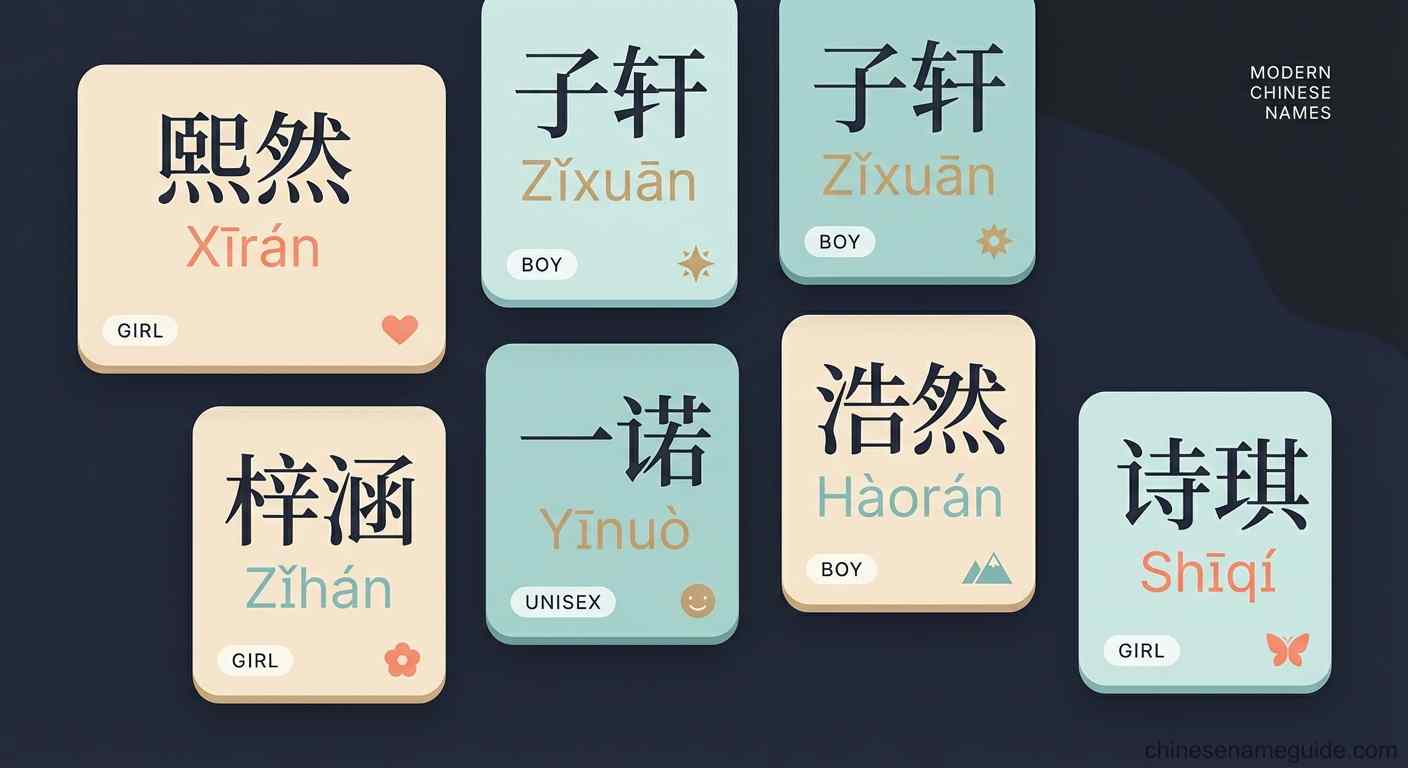
Modern Chinese Names: What Kids Are Actually Called Now
Forget Li Ming and Wang Wei. A ground-level look at what Chinese kids are really named today, what those names signal, and how to sound modern without sounding ridiculous.
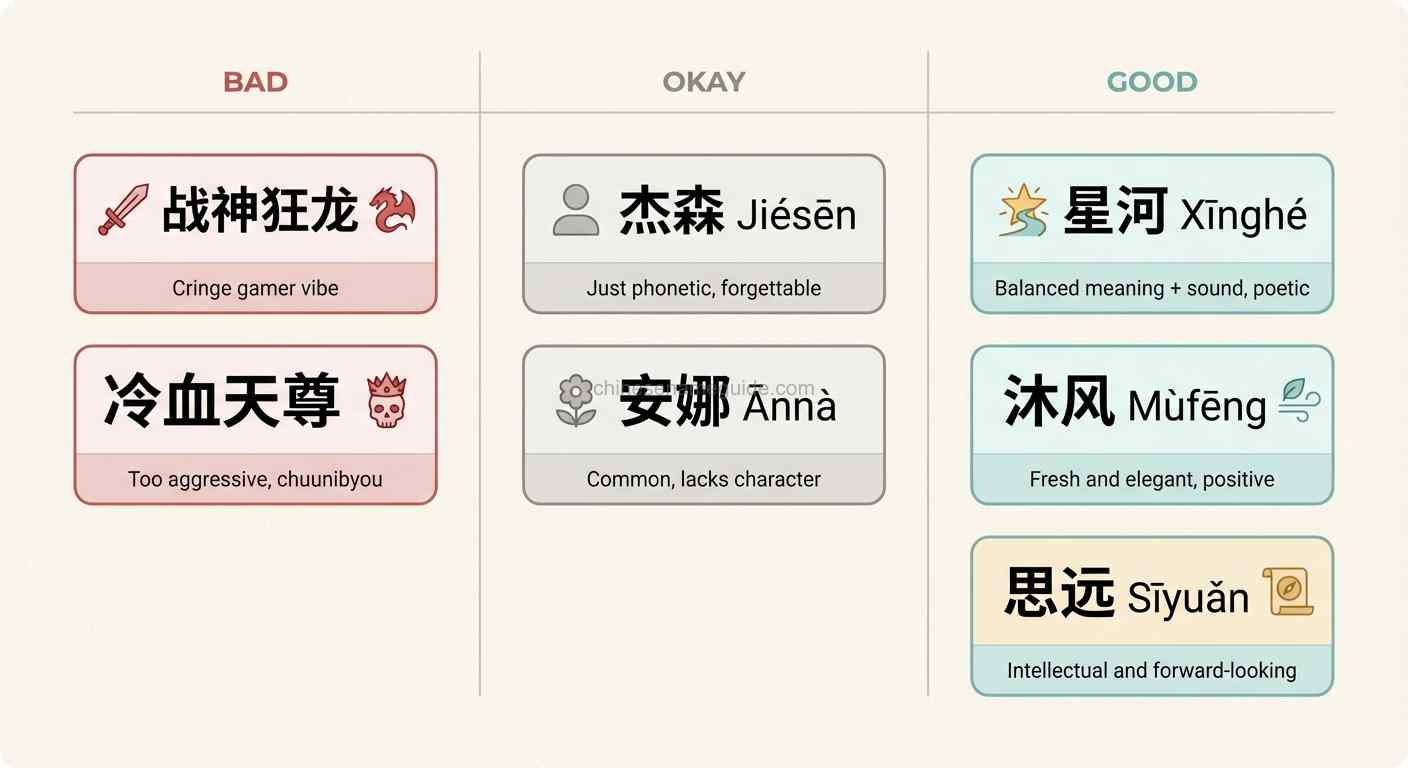
Why Most Chinese Name Generators Are Dangerous (Don't Get a Tattoo Yet!)
Before you tattoo a ‘cool Chinese name’ or launch a brand with it, read this. A brutally honest look at how most Chinese name generators actually work — and why they can quietly ruin your skin, your brand, or your reputation.